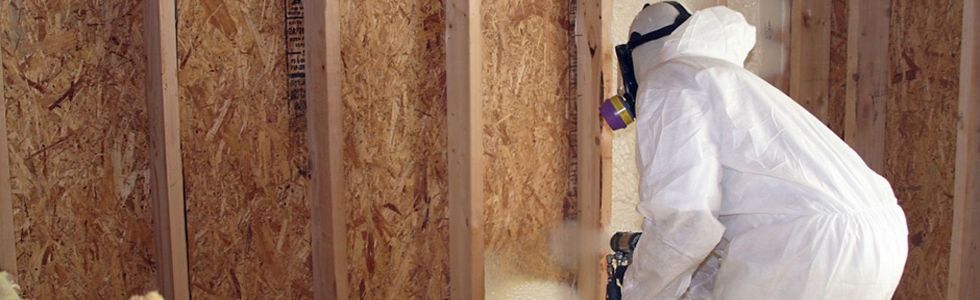
How Spray Foam Improves Commercial Building Envelope Performance
A commercial building's performance is largely determined by its envelope. Spray foam combines insulation, air barrier and vapour retarder into one continuous layer to close the gaps other systems leave open.
Helping the Commercial Building Envelope
A commercial building's performance is largely determined by its building envelope. This includes the roof, walls and all components that separate the interior from the outside environment. When the envelope is inefficient, energy loss, moisture problems and inconsistent temperatures follow.
Spray foam insulation has become one of the more effective solutions for improving envelope performance, particularly in demanding climates like Central Alberta.
What Is the Building Envelope Really Doing?
The building envelope is responsible for controlling three main things: air movement, heat transfer and moisture.
In many commercial buildings, these controls are handled by separate materials. You may have insulation for thermal resistance, vapour barriers for moisture and air barriers to reduce leakage. The problem is that gaps between these systems often lead to performance failures.
Even small discontinuities can allow air to move freely through the structure, carrying heat and moisture with it.
Spray Foam Combines Multiple Functions
One of the advantages of spray foam is that it performs multiple roles at once. When applied, it expands and adheres directly to the substrate, forming a continuous layer.
This single application acts as:
- Insulation
- Air barrier
- Vapour retarder (in closed-cell systems)
Because there are no seams or joints, the risk of air leakage is reduced significantly.
Eliminating Air Leakage
Air movement is one of the largest sources of energy loss in commercial buildings. Warm air escaping in winter and hot air entering in summer both increase the load on HVAC systems.
Spray foam creates an airtight seal across the building envelope. It fills cracks, gaps and irregular surfaces that traditional insulation cannot address as effectively — closing the same gaps Alberta's own air barrier standard is written to control, not the assembly figure, which is ten times higher. By reducing uncontrolled air movement, buildings maintain more stable indoor temperatures and place less demand on heating and cooling equipment.
Reducing Thermal Bridging
Thermal bridging occurs when heat bypasses insulation through structural elements like steel studs or framing, leading to localized heat loss and reduced overall efficiency.
Spray foam reduces thermal bridging by creating a continuous insulating layer that conforms to the structure. It reduces temperature differences across surfaces and improves overall thermal performance — especially relevant in commercial construction, where large structural elements are common.
Moisture Control and Condensation Prevention
Moisture is a major concern in building envelopes, particularly in climates with large temperature swings. When warm, moist air meets a cold surface, condensation forms. Over time, this can lead to mould, corrosion and structural damage.
Closed-cell spray foam helps control this by limiting both air movement and moisture transfer, reducing the conditions that lead to condensation and helping protect both the building and the materials within it.
A Smarter Approach to Commercial Efficiency
Improving the building envelope is one of the more effective ways to reduce energy consumption and increase comfort in a commercial space. Spray foam addresses multiple performance issues at once — and the same three-in-one logic scales up further in industrial facilities, where the envelope has to do its job at plant scale rather than storefront scale.
At NFW, we install commercial spray foam systems for Alberta conditions. As insulation contractors across Red Deer and Central Alberta, we help building owners improve efficiency, reduce energy loss and protect their structures long term.
For the exact RSI and U-value minimums Alberta's code sets for a commercial envelope in Zone 7A, see our Alberta commercial code compliance breakdown.
Need a local contractor? Get in touch — 403-350-2720.