What Is the Difference Between Spray Foam Insulation and Fibreglass?
Spray foam and fibreglass are the two most commonly used insulation materials in Alberta. Here's how they actually compare on R-value, moisture resistance and installation.
Contractors, property managers and homeowners have a range of choices when it comes to insulation products, and that can get confusing. You may be wondering which material is best for your building, your region and your budget — so here's a straightforward comparison between spray foam insulation and fibreglass, the two most commonly used insulation materials in Alberta.
Fibreglass
Fibreglass, made from fine strands of glass fibre, has been used as an insulation material since the 1930s. Today it remains one of the most common materials for ceiling and floor insulation globally, offering an R-value of about 2 to 3 per inch of thickness. R-value measures a material's resistance to heat flow, and Alberta's building code sets a different minimum RSI for each assembly — from ceilings to foundation walls — so the target moves depending on what you're insulating.
Despite its relatively low R-value per inch, fibreglass insulation is popular for its affordability and accessibility. The ease of installation means most construction crews can handle it, and many handy homeowners have installed it themselves. Installation should always be done with proper personal protective equipment, since prolonged skin contact with the fibres is uncomfortable and the fibres can irritate the nose, throat and eyes.
Spray Foam Insulation
Spray foam insulation comes in two main types used in residential, commercial and industrial properties: open-cell and closed-cell. Closed-cell spray foam is denser and offers the higher R-value of the two — Canadian LTTR testing puts closed-cell spray foam in the range of roughly R-5.2 to R-5.9 per inch, a meaningful step up from fibreglass. Open-cell spray foam has a lower R-value per inch than closed-cell but expands significantly, filling difficult-to-reach corners and crevices.
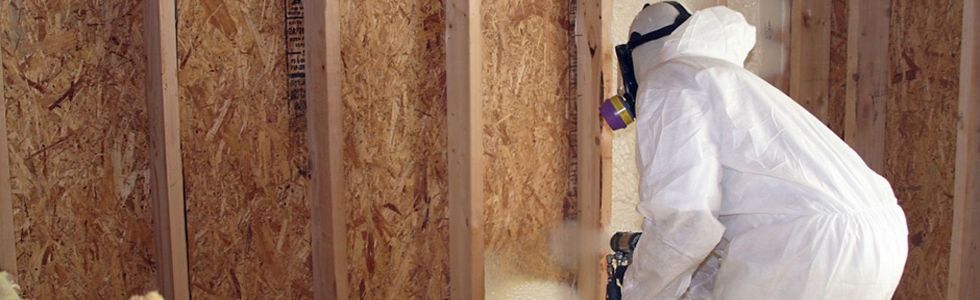
The advantage of spray foam is its ability to provide strong insulation performance without handling large foam sheets or batts. Liquid-stored foam allows for application that conforms to irregular framing and produces smooth, even coverage.
Create a Moisture Vapour Barrier with SPF
The polyurethane foam we use enhances thermal efficiency by helping keep buildings warmer in winter and cooler in summer, and closed-cell formulations also act as a moisture-resistant barrier — at the right thickness, that's not just a marketing claim, it's the exact point where Alberta's code recognizes closed-cell foam as its own vapour barrier. Compared to fibreglass, the higher upfront cost of foam insulation is offset over time by energy performance and, in humid environments, by reduced risk of moisture reaching other building materials.
Call for Spray Foam Insulation Services in Red Deer and Area
We're proud to serve the Lacombe and Red Deer region for spray foam wall insulation and vapour blasting needs. Get in touch at 403-350-2720 to schedule an appointment or ask for a quote on any of our services.